Key takeaways
- Yes, you can wear your glasses as a bride. Plan the makeup around them instead of hiding them.
- Short-sighted (minus) lenses make eyes look smaller and need more definition. Long-sighted (plus) lenses magnify them and need precise, softer work.
- Choose lashes that clear your lens when you blink, or go for curl-only or a "no lashes" minimal look.
- Set the nose bridge and under-eyes well so nose pads do not lift your base.
- An anti-reflective coating, a slight frame tilt and a quick briefing for your photographer take care of most glare.
- Bring your exact frames to your trial and test photos with flash.
In this series · Bridal looks & trends
- Bridal Makeup by Lehenga Colour: The Lip, Eye and Blush Chart for Every Skin Tone
- Celebrity Bridal Makeup Looks 2026, Decoded: How to Recreate Each One
- How Long Does Bridal Makeup Take? Your Delhi Wedding-Day Getting-Ready Timeline
- Mehendi and Haldi Makeup Looks: Fresh, Fun and Built to Last
- Minimal Bridal Makeup Trends 2026–27: The Soft-Glam Edit
If you have worn specs since school, the idea of taking them off for your own wedding can feel strange. The good news is that bridal makeup with glasses can look beautiful, intentional and completely like you. It just needs a few adjustments that most guides skip: how your lens type changes the way your eyes look, how long your lashes can be, and how a nath and maang tikka share space with a frame.
Brides with glasses are no longer rare in Indian weddings. Comedian Shreeja Chaturvedi, for example, wore her regular glasses with a red saree and minimal makeup at her early-2026 wedding, and the photos were warmly praised online. This guide walks you through every decision, from glasses vs lenses to what to tell your photographer.
Glasses or contact lenses on your wedding day?
Wear whatever lets you see clearly and feel like yourself for a long day. Contact lenses suit brides who already wear them comfortably. Glasses suit brides with dry or sensitive eyes, a complex prescription, or a face they only recognise in specs. Many brides mix both across functions, which is often the easiest answer.
Use this table to think it through honestly. There is no wrong choice, only the one that keeps you comfortable from the first function to the last pheras.
| Factor | Glasses | Contact lenses |
|---|---|---|
| Comfort over 10+ hours | Easy if the frame fits well; nose pads can press by evening | Easy if you are a regular wearer; harder if your eyes dry out under stage lights |
| Prescription | Works for any prescription, including progressives | Depends on what your optometrist says suits your eyes |
| Dry or sensitive eyes | Usually the safer option | Smoke from the havan, dust and long hours can irritate |
| Functions | Natural for haldi, mehendi and sangeet when you want to see and enjoy everything | Popular for the pheras and portraits |
| Photos | Need anti-glare coating and a little posing awareness | No reflections; eye makeup shows fully |
| Feeling like yourself | Ideal if specs are part of your identity | Ideal if you have always wanted to see your bridal eyes without a frame |
If you are switching to lenses: practise weeks ahead
If you plan to wear contact lenses, start practising a few weeks before the wedding, and check with your optometrist on the right type and wearing time for your eyes. Put your lenses in before your makeup starts, never after, and always carry your glasses and a spare pair of lenses.
- Practise on busy days. Wear them through a long family function or a full workday, so you know how your eyes feel by evening.
- Lenses first, makeup second. Putting lenses in after eye makeup can drag liner, mascara or glitter into your eyes. Tell your artist you will arrive with lenses already in.
- Pack a small kit. Your glasses, a lens case, solution and any eye drops your optometrist has recommended, handed to a sister or bridesmaid who stays near you.
- Do not try something new on the day. Coloured or new-brand lenses that you have not worn before are not a wedding-day experiment.
Mention your lens plan when you book. It is one of the useful points on our list of questions to ask a makeup artist before booking.
How your lenses change your eye makeup
Your prescription changes how your eyes look through the glass, so it changes your bridal eye makeup too. Short-sighted (minus) lenses make eyes appear smaller, so they need more definition. Long-sighted (plus) lenses magnify the eyes, so every line and blend shows. Thick, progressive or tinted lenses need their own small adjustments.
Short-sighted (minus) lenses
Minus lenses shrink the eye area slightly, and the eyes can look a little recessed behind the frame. The goal is to bring them forward.
- Tightline the upper waterline with a dark brown or black pencil so the lash line looks fuller.
- Use a slightly deeper crease shade than you would without glasses, blended well above the crease.
- Brighten the inner corners and centre of the lid with a soft champagne or gold shimmer.
- Add soft definition on the outer third of the lower lash line so the eye shape reads from a distance.
- Curl your lashes well and use a lengthening mascara, since lashes visible through the lens open up the eye.
Long-sighted (plus) lenses
Plus lenses magnify, which is lovely for the eyes but unforgiving of mistakes. Smudgy liner, patchy concealer or clumpy mascara will all look bigger.
- Keep liner thin and crisp, and smoke it out gently rather than drawing a heavy wing.
- Choose matte or satin eyeshadow textures over chunky glitter, which can look grainy when magnified.
- Blend every edge carefully, and use a light hand with under-eye concealer so it does not crease.
- Comb through mascara so each lash is separated.
Thick, progressive or tinted lenses
- Thick lenses can create a visible ring or shadow at the edge. A slightly brighter under-eye and well-defined brows help balance this.
- Progressive lenses distort differently at the top and bottom. Check your makeup while looking straight ahead, the way you will in most photos.
- Tinted or light-reactive lenses can darken outdoors and hide your eyes completely. For an outdoor varmala or daytime pheras, a clear pair is the safer option.
Eye makeup that shows through frames
The eye makeup that works best behind glasses starts with groomed, well-filled brows, then a tightlined upper lash line, liner weight matched to your frame, and soft lower-lash definition. Together these keep your eyes visible and expressive instead of lost behind the glass. Here is how to get the look, step by step.
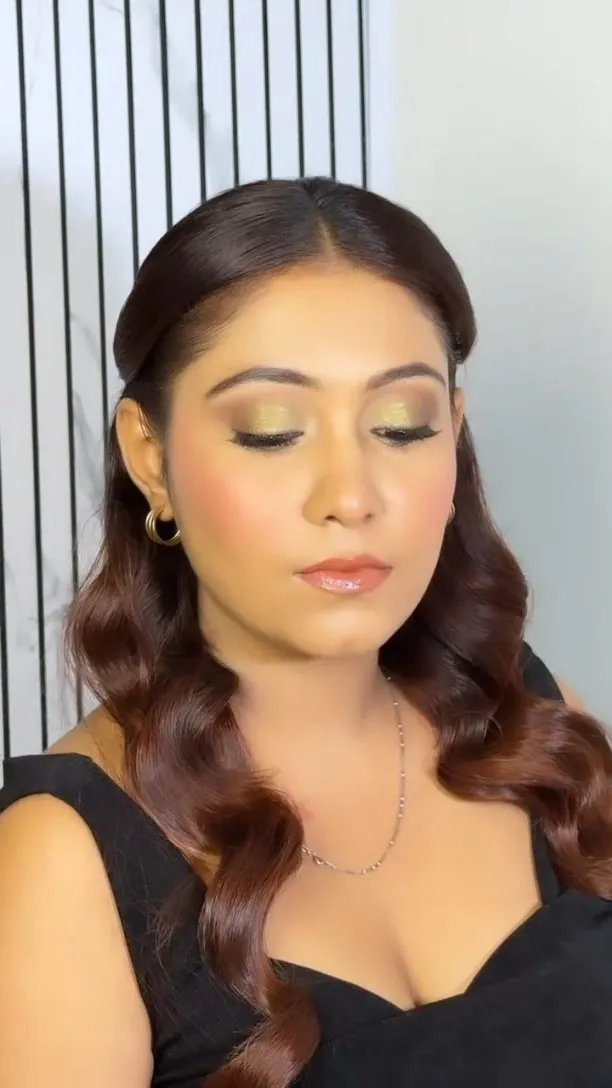
- Brows first. Frames sit close to the brow line, so brows become part of the frame. Fill them with fine, hair-like strokes and set with a clear or tinted brow gel. Keep the shape natural; very sharp, blocky brows can clash with a strong frame.
- Prime the lids. An eyeshadow primer stops creasing, which matters more when a lens is magnifying or framing your eyes.
- Build a soft crease. A warm brown or soft mauve, depending on your outfit, blended above the crease gives depth without heaviness.
- Tightline. A waterproof pencil along the upper waterline makes lashes look thicker without adding width on the lid.
- Match liner to the frame. Thin frames take a fine flick. Bold frames can carry a slightly stronger line, but keep the wing short and lifted so it does not disappear behind the frame edge.
- Define the lower lashes. A smudged brown or kohl on the outer third, softened with a brush, frames the eye from below.
- Light the inner corner. A touch of soft shimmer here brightens tired eyes after a week of functions.
Lashes that don't touch your lenses
You can wear false lashes with glasses, as long as they clear the lens when you blink. Wispy, short or half lashes on the outer corners usually work best. Curling and coating your own lashes works beautifully too, and a "no lashes" minimal look is a clean, modern choice for brides with specs.
| Lash option | Works for | Watch out for |
|---|---|---|
| Wispy natural strip lashes | Frames that sit a little away from the face | Length; trim if they brush the lens |
| Half lashes or clusters on outer corners | Most frames; lifts the eye without hitting the centre of the lens | Placement in line with your natural lash direction |
| Curl-only with mascara | Close-fitting frames and plus lenses | Clumps, which a magnifying lens makes obvious |
| No lashes | Soft, minimal bridal looks; brides who dislike the feel of lashes | Needs a good tightline and lower-lash definition |
Test this with your frames on. Blink, look up, smile widely, because cheeks lift the frame when you laugh. If anything touches the glass, go shorter. Priyanka's signature "minimal magic" style includes "no lashes" minimal looks, which suit specs naturally, and full glam is available on request.
A base that stays put under frames
To stop your base lifting under glasses, keep foundation thin on the nose bridge and where frames touch the cheeks, press setting powder into those spots, and let a setting spray dry fully before the frames go on. Under-eye concealer needs to be light and well set, because lenses frame that area closely.
- Nose bridge. Use the thinnest layer of base here, then press in a fine translucent powder. Nose pads rub through thick foundation within an hour.
- Under-eyes. A light, hydrating concealer in a peach or salmon tone for dark circles, set with a small brush. Too much product creases and shows through the lens.
- Cheeks under the frame. If your frames touch your cheeks when you smile, keep blush and highlighter slightly below that line.
- Setting spray. Mist, wait until it is fully dry, then put your glasses on gently. This one pause saves the most touch-ups.
- Touch-up kit. A microfibre cloth, blotting papers and a small powder compact. Ask someone close to carry it for you.
Delhi's dry winter air and humid monsoon weddings both affect how long the base holds, so your artist will adjust the products for the season. If you are planning your wedding look around glasses, the bridal makeup service in Delhi page explains how Priyanka works across functions.
Bookings open for 2026 – 27
Planning your look? Let's talk.
Share your date, functions and venue – Priyanka will reply with availability and a personalised quote.
Frames with nath, maang tikka, matha patti and dupatta
Glasses, a nath, a maang tikka and a dupatta can all work together when they do not compete for the same space. Thin metal, rimless or clear frames leave the most room for jewellery. Bold frames work too, but keep jewellery near the eyes lighter, and check how the nath chain and dupatta sit with the temple arms.
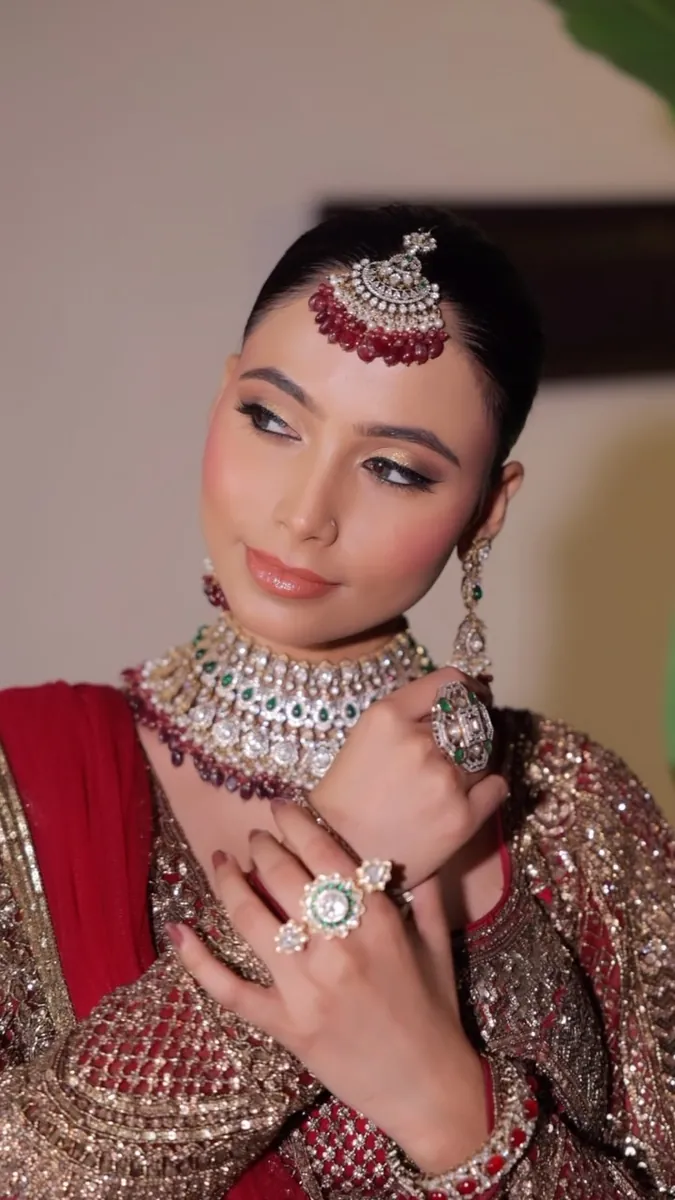
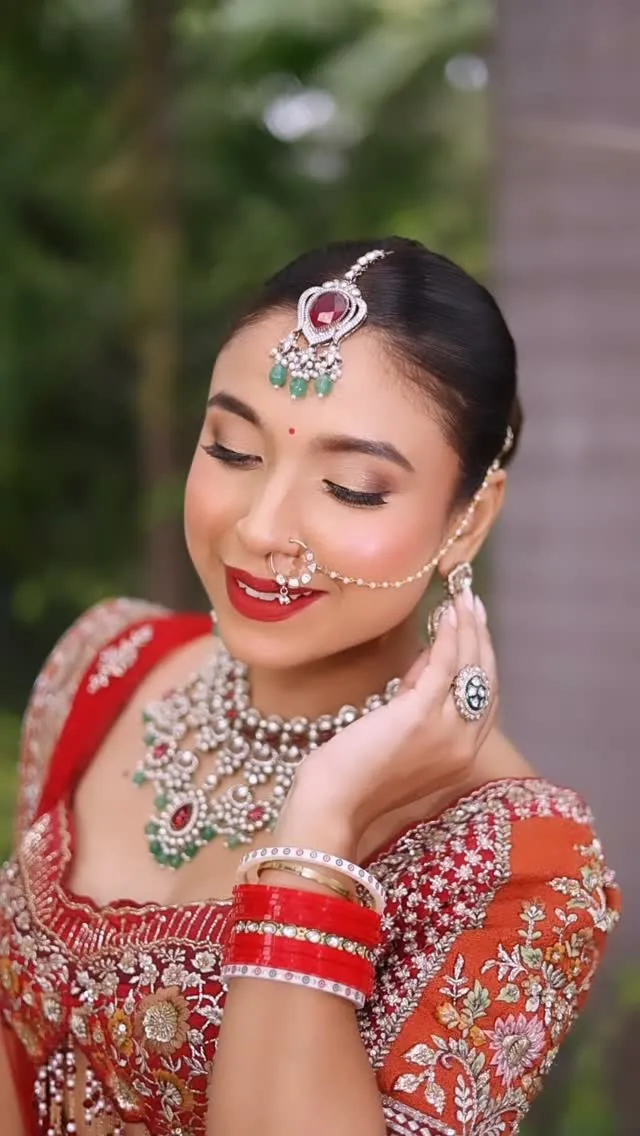
- Nath. The nath and the nose pads sit close together. A smaller nath, or one worn on the side that leaves the frame clear, avoids pressure and tangles. Make sure the chain hooks into your hair or earring without crossing the temple arm.
- Maang tikka. Let it fall in the centre of the forehead, ending above the bridge of the frame. If your frames are tall, a shorter tikka keeps it from resting on the glass.
- Matha patti. The side strands should sit above or behind the temple arms, not trapped under them. Try it with your frames at the trial.
- Jhumkas and earrings. Heavy earrings and temple arms both rest near the ear. Lighter earrings or ear chains that support the weight are more comfortable over long hours.
- Dupatta. Pin the dupatta behind the ears or over the hair so it does not push the frames forward when you move.
Hair is styled by Priyanka's partner hair artists, booked together on request, so mention your frames when you plan hair too. A soft, slightly loose style around the ears sits more comfortably with temple arms than a tight, scraped-back bun.
Glare and flash: what to tell your photographer
Most glare in wedding photos is fixed by three things: an anti-reflective coating on your lenses, a slight downward tilt of the frame during posed portraits, and a quick briefing so your photographer can angle or bounce the light. Brief them before the wedding, not during the pheras.
- Get anti-reflective coating early. If your current lenses do not have it, ask your optician well before the wedding, so you have time to get used to the new pair.
- Clean lenses before every portrait. Fingerprints and makeup smudges show up clearly in photos.
- Tilt slightly. Lowering the frame a little at the temples, or tilting your chin down a touch, moves reflections away from your eyes in posed shots.
- Brief your photographer. Tell them you will wear glasses, and ask for bounced or off-camera light where possible, especially for close portraits.
- Plan a few frames-off shots. If you want some eye close-ups without glasses, schedule them for a calm moment, then put your specs back on.
- Watch stage lights. Bright LED stage lights at receptions can create strong reflections. A quick test shot on stage before guests arrive helps.
Balancing lips and blush with bold vs thin frames
With bold or dark frames, a defined lip and soft blush balance the face, because the frame already adds weight near the eyes. With thin, rimless or clear frames, you can carry more eye detail and choose either a soft or a bold lip. The aim is one strong feature near the eyes, not three.
| Frame | Lip | Blush | Eyes |
|---|---|---|---|
| Thick black or dark tortoiseshell | Classic red, brick or berry for balance | Soft rose or peach | Clean definition; avoid heavy smoky eyes |
| Gold or rose-gold metal | Warm nude, coral or soft red | Peach or warm pink | Gold and bronze tones echo the frame |
| Rimless or clear | Any, from glossy pink to deep maroon | Flushed and natural | Most freedom; eye detail shows fully |
| Coloured frames (pink, wine) | A shade that matches or softens the frame | Sheer, close to the lip tone | Neutral, so colour stays on the frame |
For a red bridal lehenga, a classic red lip with soft brown eyes usually photographs well with almost any frame. For pastel lehengas, a glossy pink or nude lip keeps the whole look light.
Function-wise plan and your trial
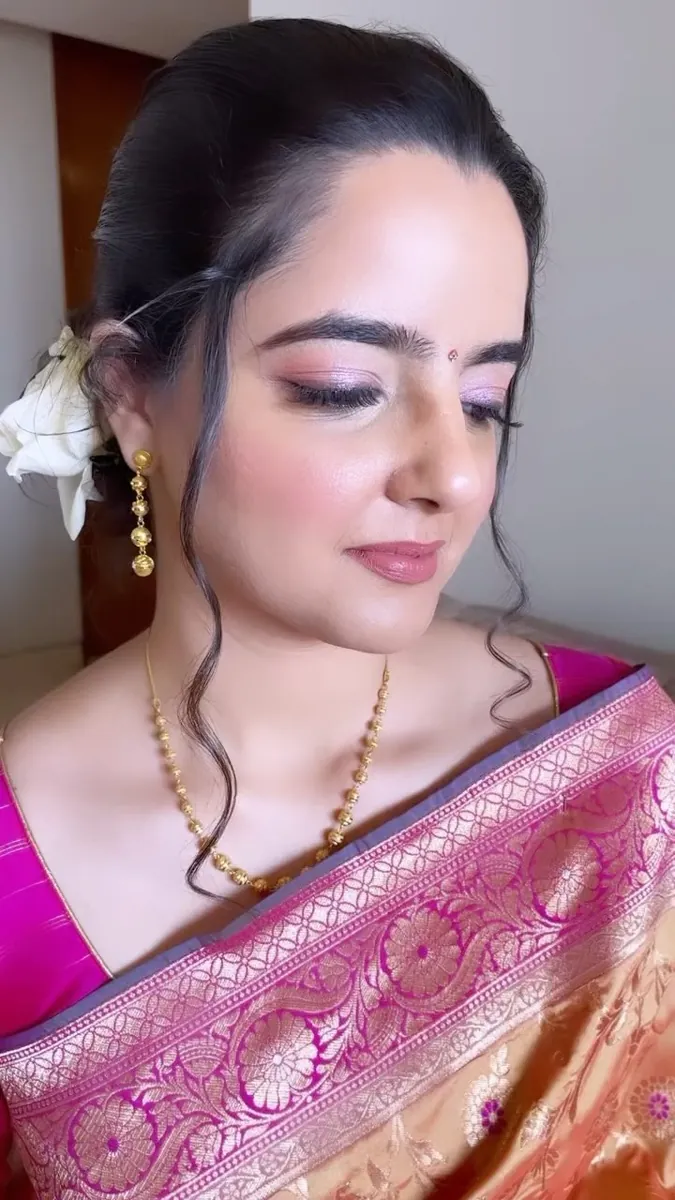
A simple plan is specs for haldi and mehendi, lenses or specs for the pheras, and whatever is most comfortable for the reception. Whatever you choose, wear your exact frames or lenses to your makeup trial and take test photos with and without flash so the look is adjusted before the day.
| Function | Specs or lenses | Makeup note |
|---|---|---|
| Haldi | Specs, or an older pair you do not mind getting turmeric on | Minimal, water-resistant base; skip lashes |
| Mehendi | Specs, so you can see the designs and enjoy the day | Fresh, glowy skin with soft eyes |
| Sangeet or cocktail | Either; frames can be part of the outfit | A little more shimmer or a bolder lip |
| Wedding and pheras | Lenses if you are a confident wearer; specs if they are you | Full bridal look adapted to your choice |
| Reception | Either | Check stage-light glare with a test shot |
For daytime function looks, see our ideas for mehendi and haldi makeup. Before your trial, read the bridal makeup trial guide and add these glasses-specific checks:
- Bring the exact frames you will wear, and your lenses if you are considering them.
- Check lash length with the frames on while you blink, laugh and look up.
- Take photos in daylight, indoor light and with flash.
- Wear the look with frames for a few hours to see how the nose bridge holds.
- Try your maang tikka, nath or matha patti with the frames if you can.
Priyanka is a Delhi-based bridal makeup artist whose signature "minimal magic" style, a clean, softly defined face with flushed skin, works naturally with specs. She travels to homes, hotels and venues across Delhi NCR. Bridal makeup starts from ₹20,000, and packages depend on your date, functions and location; you can see more on the bridal makeup price in Delhi page or share your details on WhatsApp for a quote.
Bookings open for 2026 – 27
Planning your look? Let's talk.
Share your date, functions and venue – Priyanka will reply with availability and a personalised quote.